Confectionery consumption in childhood and adult violence
Moore SC, Carter LM, van Goozen S. (2009) Br J Psychiatry 195(4) 366-7. doi: 10.1192/bjp.bp.108.061820.
Web URL: Read this and related abstracts via Pubmed here. Free full text of this article is available online
Abstract:
Summary
Diet has been associated with behavioural problems, including aggression, but the long-term effects of childhood diet on adult violence have not been studied.We tested the hypothesis that excessive consumption of confectionery at age 10 years predicts convictions for violence in adulthood (age 34 years). Data from age 5, 10 and 34 years were used.
Children who ate confectionery daily at age 10 years were significantly more likely to have been convicted for violence at age 34 years, a relationship that was robust when controlling for ecological and individual factors.
-------------------------------------------------------------------------------------------------------------------------------
Introduction
Childhood factors that influence the expression of violence in adulthood are numerous and include economic, ecological and individual factors (such as personality traits).(1)
Diet has been causally associated with population mortality rates, neurocognitive deficits, disruptive behaviour, antisocial and aggressive behaviour, and offending behaviour in a prison population.(2)(5)
Furthermore, decision biases, such that rewards are subjectively overweighted and punishment underweighted, are associated with delinquency.(6)
Confectionery (sweets/chocolates), often used as a quick reward for children, has also received attention,(3)(7) although studies have mostly focused on the short-term effects of diet on behaviour: the long-term effects have yet to be determined.
The objective of our study was to extend what is currently known about childhood risk factors for violence by also considering the role of confectionery. We hypothesise that excessive confectionery consumption increases the likelihood of violence in adulthood.
Method
Our analysis included data on the births and families of babies (respondents, hereafter) born in the UK in one particular week (n = 17 415) derived from the British Cohort Study which began in 1970. Information was requested on all babies born (alive or dead) after the 24th week of gestation from 00:01 on Sunday 5th April to 24:00 on Saturday 11th April 1970. It is estimated that not more than 5% and not less than 2% of all births were missed. Since 1970 there have been seven data collections designed to monitor respondents' health, education, social and economic circumstances. These additional waves took place when respondents were aged 5, 10, 16, 26, 30, 34 and 42 years.
We used data from the age 10 wave when respondents were asked how frequently they consumed confectionery, and the age 34 wave, when self-report violent offending data and additional information on socioeconomic status were collected.
Additional data were taken from the age 5 wave that characterised respondents' early development, including parenting style. Respondents were coded positive for perpetration of violence (violence, hereafter) if the most recent offence, between the age 30 and age 34 surveys, for which they were found guilty involved violence. Violence data were collected using a reliable self-report computer-assisted interview methodology.(8)
Confectionery consumption was reduced to a binary variable (every day = 1, less often or never = 0) owing to small numbers in the violence variable. To check the robustness of estimates we regressed confectionery consumption onto violence and then incrementally added control variables. With no substantial change in either the sign or significance of the effect of eating confectionery, we then sought the most parsimonious model by removing control variables that yielded no significant association.
Numerous control variables were entered into initial models, including information on: the child's behaviour at home at age 5 years and maternal circumstances based on the Rutter A Scale of behavioural deviance (completed by a parent, usually the mother, and designed to measure behaviour-adjustment problems) and the Malaise Inventory (a 24-item self-completion scale designed to assess psychiatric morbidity);(9) aggression and impulsivity at age 10 years, assessed by the child's class teacher; mental ability at age 5 years, derived from figure drawing and vocabulary tests, reduced to a single mental ability score using a procedure described by Batty(10) and validated against a health visitor's subjective assessment of ability.
Forty-three questions were used to assess parental attitudes in the age 5 wave and iterated principal factor analysis with an oblique rotation method(11) (Kaiser–Meyer–Olkin measure of sampling adequacy 0.88) yielded three factors: an authoritarian attitude to parenting, mothers' perceptions of their rights, and a parenting style that is more liberal and affords children greater freedom.
Across all models the association between eating confectionery daily remained statistically significant. As the binary outcome variable, violence, is a rare event (0.47%) and the statistical analysis of rare events (<5%) presents problems, particularly for logistic models,(12) a rare event logistic model(12) with cluster correction on government office region was the preferred analytic strategy.
Results
Overall, 69% of respondents who were violent by the age of 34 years reported that they ate confectionery nearly every day during childhood, compared with 42% who were non-violent.
Table 1 presents statistics from the final regression model.
Tests for collinearity in independent variables yielded variance inflation factors less than 1.05. Spearman correlation coefficients suggested weak (ρP
Table 1 Results from a rare events logistic multiple regression model indicating a significant association between daily confectionery consumption at age 10 years and conviction for violence by 34 years a
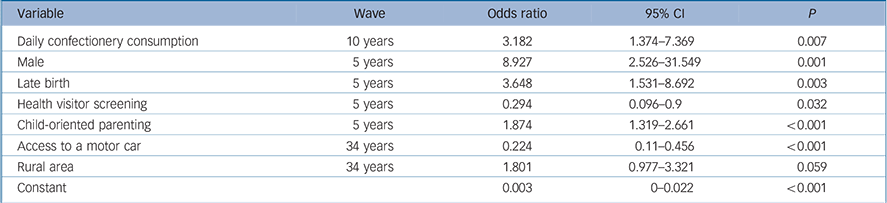
a. Observations n = 6942.
The rare events logistic regression model (Table 1) yielded a significant relationship between eating confectionery at age 10 years and violence at age 34 years. This association was consistent across all models where ecological, childhood and other controls were included.
Other significant relationships between control variables and violence included a child's gender and parents' attitudes towards parenting. Health visitor screening during childhood protected against adult violence. Having access to motorised transport at age 34 years protected against adult violence, whereas living in a rural area at age 34 years increased the risk of violence.
Attrition and non-response bias mean that the data available for analysis may not be characteristic of the larger population, which might affect our conclusions.
Discussion
Analysis of the British Cohort Study has the advantage of a large sample size and the opportunity to control for numerous potential confounds. However, as a general population cohort study it was not designed to specifically examine the nature of diet and how it might be related to behaviour in the long-term.
Exogeneity, whereby a third unmeasured variable promotes both dietary choice and violence across the lifespan (e.g. a genetic factor), is unlikely because dietary choices for 10-year-olds are primarily governed by their immediate circumstances, in particular their parents and primary carers, and these factors are already accounted for in the model presented here.
Moreover, self-report data provide an accurate source of behavioural information (8) and having controlled for numerous control variables suggest that the relationship between confectionery consumption and violence is both novel and robust.
Candidate mechanisms linking confectionery consumption to adult violence must account for enduring changes into adulthood. One plausible mechanism is that persistently using confectionery to control childhood behaviour might prevent children from learning to defer gratification, in turn biasing decision processes towards more impulsive behaviour, biases that are strongly associated with delinquency.(6)
Furthermore, childhood confectionery consumption may nurture a taste that is maintained into adulthood, exposing adults to the effects of additives often found in sweetened food,(3) the consumption of which may also contribute towards adult aggression.
Moreover, although parental attitudes were associated with adult violence, the effect of diet was robust having controlled for these attitudinal variables. Irrespective of the causal mechanism, which warrants further attention, targeting resources at improving childhood diet may improve health and reduce aggression.
Funding
The research was supported by a grant from the Economic and Social Research Council (ES/D000483/1).
References
FAB RESEARCH COMMENT:
This large-scale UK population study found that higher childhood consumption of sweets and confectionery predicted subsequent convictions for violent offences in adulthood.The data used were from a large National Birth Cohort study - which allowed the researchers to control for numerous other factors already known to increase risks for violence and other forms of antisocial behaviour.
As the authors acknowledge, this was an observational study, and so cannot provide any definitive evidence of causality. However, it makes an important addition to the mounting evidence that nutritionally poor diets (which by definition are likely to compromise brain development and function) may be an important and modifiable risk factor for aggression and violent behaviour.
Previous research has already provided evidence of causal effects of nutritional status on violence - from rigorously conducted randomised controlled trials of dietary supplementation in young offenders. See:
And for further information on this subject, please bookmark the following lists, which are frequently updated.

Food and Behaviour Research is a registered charity (No SC034604) and a company limited by guarantee (Co No SC 253448)
Newsletter Signup
Useful Links
Contact Us
FAB Research
23 Carlton Road
Oxford
OX2 7SA
Important Notice
Medical opinion and guidance should always be sought for any symptoms that might possibly reflect a known or suspected disease, disorder or medical condition. Information provided on this website (or by FAB Research via any other means) does not in any way constitute advice on the treatment of any medical condition formally diagnosed or otherwise.
Site by Redstone Websites. Easy to Use Web Content Management. 2026 © All Rights Reserved.