PRESS RELEASE: Low Fish Intake, Low Mental Wellbeing: Study Reveals Students’ Omega-3 Shortfall
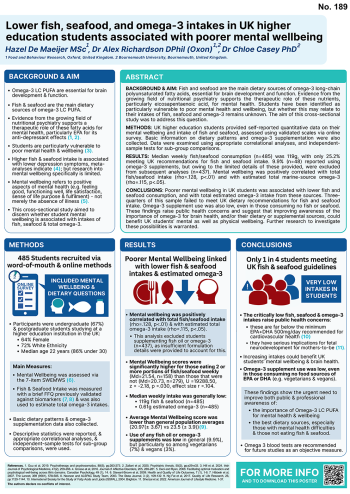
Long chain omega-3 fats, found predominately in fish and seafood, are crucial for healthy brain function, yet new research shows most UK university students fall short of national intake guidelines, and rarely use supplements to fill such gaps. Founder Director Dr Alex Richardson represented FAB Research at the 16th Congress of ISSFAL 2025 in Quebec City - the bi-annual international conference from the foremost International Scientific Society dealing exclusively with the health impact of dietary lipids. There she shared new and unpublished data showing evidence that poorer mental wellbeing i
Download File: Download the poster for more information about this study (2.7 MB)
FAB RESEARCH COMMENT:
Read the underlying research here:
For further research & information on connected topics, please see:
See also:
- FAB Webinar - Feeding Humanity: The Key Role of Nutrition in the Mental Health Crisis, with Professor Michael Crawford
- FAB Webinar - Alcohol: What Women Need to Know, with Dr Chloe Casey
- FAB Webinar - ADHD and Mood: Why Food Matters, with Hazel De Maeijer & Dr Alex Richardson
Long chain omega-3 fats, found predominately in fish and seafood, are crucial for healthy brain function, yet this new research shows most UK university students fall short of national intake guidelines, and rarely use supplements to fill such gaps.
In this new study from Hazel De Maeijer ANutr and Dr Alex Richardson of FAB Research, and Dr Chloe Casey of Bournemouth University, analysis of nearly 500 students revealed that those who ate more fish or seafood - and thus more omega-3 - tended to report higher mental wellbeing scores.
The research also highlighted that, in this group particularly vulnerable to poor mental health and wellbeing (UK university students), intakes of fish & seafood (the main sources of long chain omega 3s) are being consumed at very low levels - a concern to both general physical health as well as brain health.
Median weekly intake was generally low: 119g fish & seafood (n=485) 0.61g estimated omega-3 (n=485) - meaning that only 1 in 4 students were found to be meeting UK fish & seafood guidelines.
Use of any fish oil or omega-3 supplements was low in general (9.9%), but particularly so among vegetarians (7%) & vegans (3%).
The critically low fish, seafood & omega-3 intakes observed also raise public health concerns:
- these are far below the minimum EPA+DHA 500mg/day recommended for cardiovascular health
- they have serious implications for fetal neurodevelopment for mothers-to-be.
These findings show the urgent need to improve both public & professional awareness of:
- the importance of Omega-3 LC PUFA for mental health & wellbeing
- the best dietary sources, especially for those with mental health difficulties & those not eating fish & seafood e.g. algal alternatives rich in EPA & DHA.
It is likely that this association between fish consumption and improved wellbeing and health, is mediated by the omega-3 PUFAs found in relatively high concentrations in fish & seafood. The increasingly documented antidepressant, neuroprotective and brain function benefits of these special fats could explain why mental wellbeing scores were significantly lower for students falling below UK seafood guidelines, though further RCTs would be required to clarify causality in this population.
Raising awareness about the brain-related benefits of marine omega-3s could be an easy & affordable way to support student mental health - and protect them from potentially harmful deficiencies.
Separate from mental benefits, improved intakes of both oily fish and/or omega-3 would, through implementation of educational or public health initiatives, likely result in wider cardiovascular and general health benefits as documented by global experts. Student-targeted initiatives also offer a prime opportunity for related nutritional-education given that the life-stage of adolescence is when many new health behaviours are adopted or discontinued.

Food and Behaviour Research is a registered charity (No SC034604) and a company limited by guarantee (Co No SC 253448)
Newsletter Signup
Useful Links
Contact Us
FAB Research
23 Carlton Road
Oxford
OX2 7SA
Important Notice
Medical opinion and guidance should always be sought for any symptoms that might possibly reflect a known or suspected disease, disorder or medical condition. Information provided on this website (or by FAB Research via any other means) does not in any way constitute advice on the treatment of any medical condition formally diagnosed or otherwise.
Site by Redstone Websites. Easy to Use Web Content Management. 2026 © All Rights Reserved.