PRESS RELEASE: Early Years Nutrition in Crisis: Cross Party Group Report Warns UK Children Face ‘Shorter, Unhealthier Lives’
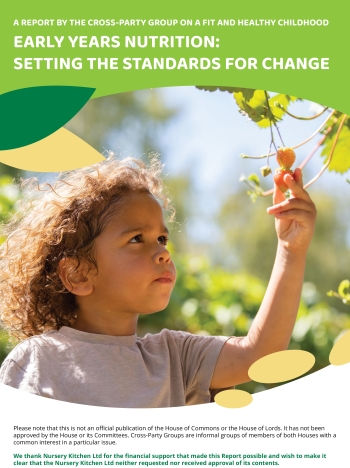
New report warns that poor nutrition in babies and toddlers is fuelling a future public health crisis and calls on the Government to act now.
Web URL: Download the full report here
FAB RESEARCH COMMENT:
We are thrilled to share some exciting news regarding the very recently published "Early Years Nutrition: Setting the Standards for Change" report by the Cross-Party Group on a Fit and Healthy Childhood – for which FAB Research provided written contributions.
We are proud to see that some of the evidence-based insights and recommendations we put forward have been included in the final published report, marking a tangible step towards improving early years nutrition in the UK, and recognising the vital role of maternal nutrition.
The report was released yesterday (16th July 2025) following a Parliamentary Reception, hosted by Anna Sabine MP at the House of Commons, to launch the report.
Uniting experts from health, research, education and the early years sector, this landmark report highlights a growing crisis: poor nutrition in the earliest years of life is being overlooked, and the price is children’s future health and wellbeing.
-
Read the full report here.
FAB Research’s Founder Director Dr Alex Richardson and nutritionist Hazel De Maeijer, played a role in shaping the content of Chapter 1 of this report, on Preconception and Pregnancy.
Whilst we develop a special briefing document for our invaluable FAB Associates on our own complete paper contribution, focused on maternal nutrition, we are delighted to update you - our wider audience & the public - regarding some of FAB’s key contributions that were incorporated into the newly published report:
Emphasised the fundamental importance of maternal nutrition in the preconception and pregnancy period for lifelong health outcomes
Our contributing submission focused on maternal nutrition, and was clearly reflected in the Cross-Party Group report: "Improving the nutrition of mothers both before and during pregnancy helps to prevent lifelong illness and disability and provides a foundation for the health and wellbeing of present and future generations."
-
Find more from FAB on the importance of early life nutrition here.
Highlighted Omega-3s' impact on pre-term birth and gaps in the NICE Guidelines
Long-chain omega-3s play a role in the reduction in incidence of pre-term birth; the single biggest cause of mental and physical illness and neonatal death in the UK.
The report mirrors our concerns that this risk factor (low long-chain omega-3 status) is absent from UK guidelines e.g. ‘Since 2015, studies worldwide have shown that increasing omega-3 intake during pregnancy reduces pre-term birth, but recently revised NICE guidelines for nutrition in pregnancy do not mention this (NICE (2025)).’
-
You can find FAB's own coverage of these issues here.
Provided clear recommendation for screening & supplementation of Omega-3
The report aligned with FAB’s own stance and recommendations, stating that "If the Government wishes to achieve better prevention of long-term health conditions, implementing evidence-based guidelines to reduce pre-term births via screening of omega-3 intake in pregnant women (using a brief, validated questionnaire) followed by supplementation as necessary makes sense.’’
-
Again, you can find FAB's own breakdown of this issue here.
Drew attention to the low intake of fish & seafood - the primary source of long-chain Omega-3 - among UK women of childbearing age
The report clearly describes some of the alarming intake research we put forward, for example that only a small minority of teenage girls and young women meet dietary requirements for fish and seafood (citing research from expert nutritionist and FAB Speaker Dr Emma Derbyshire).
Highlighted common deficiencies of other key brain-essential nutrients
The report discusses iodine deficiency, its link to IQ, and the fact that "1 in 9 women are iodine-deficient in the preconception period". It also reflects FAB Research's broader concerns regarding the potential impact of plant-based diets on nutrient deficiencies, such as iodine, and also flags the low vitamin D status of UK women.
-
Read FAB's article on iodine in pregnancy here.
We hope these important contributions from FAB Research represent a significant step forward in advocating for better nutrition considerations & policies that will benefit children and families across the UK.
We will continue to champion these crucial issues as the report's recommendations are considered for implementation.
Read these related FAB articles:
For more information, see also:
For an expert discussion of these issues, see our recent FAB webinar:
And to learn more about the extensive scientific and real-world evidence that the benefits of eating fish and seafood in pregnancy far outweigh possible risks (and alternative ways to get those benefits for vegans, vegetarians or other non-fish-eaters), see this 'masterclass' webinar from a world-leading expert in this area:
Fish and seafood is also one of the only dietary sources of Vitamin D - although bright sunlight on the skin is the main source, and modern lifestyles (and diets) mean that most of the UK population has low or suboptimal levels during the winter months, if not all year round.
Vitamin D deficiencies and insufficiencies in pregnancy have also been repeatedly linked with higher risks for ADHD, autism and schizophrenia in the offspring - and poorer neurodevelopmental and mental health outcomes in general than for babies whose mothers have adeqqate Vitamin D during pregnancy.
For more information on this topic, please see the following lists, which are regularly updated:
16 July 2025 - PRESS RELEASE: Early Years Nutrition in Crisis: Cross Party Group Report Warns UK Children Face ‘Shorter, Unhealthier Lives’.
---------------------------------------------------------------------------------------------------------------------------------------
A new report warns that poor nutrition in babies and toddlers is fuelling a future public health crisis and calls on the Government to act now.
Nursery Kitchen is proud to sponsor and contribute to a hard-hitting new report by the Cross-Party Group on A Fit and Healthy Childhood: Early Years Nutrition – Setting the Standards for Change.
Uniting experts from health, education and the early years sector, this landmark report highlights a growing crisis: poor nutrition in the earliest years of life is being overlooked, and the price is children’s future health and wellbeing.
The statistics are stark:
- Obesity levels in preschool children are rising and prevalence in children from the most deprived areas of the UK is more than double that of those living in the least deprived areas.
- The proportion of ultra-processed foods (UPFs) in children’s diets rises between 18 months and 3.5 years, while consumption of healthy, nutrient-rich foods declines.
- Around 60,000 school days are lost every year because of children being admitted to hospital for dental extractions.
From pre-conception to pre-school, from food and nutrition to physical activity and dental health, the report’s blueprint for change calls for:
- A national nutrition strategy covering preconception, pregnancy, and postnatal periods, with professional training and expanded access to schemes like Healthy Start to reduce health inequalities.
- Mandatory nutrition composition standards for commercial baby and toddler food and drink products.
- Mandatory marketing and labelling standards for commercial baby and toddler food and drink products.
- The inclusion of baby and toddler commercial food and drink products in placement, price, and advertising restrictions.
- Targeted investment for research in early years nutrition.
- Improved access to training and resources for early years staff to help implement the new EYFS nutrition guidance.
- A consistent, practical system to monitor and assess adherence to nutrition standards in early years settings.
- The extension of free school meals (FSM) to children in early years settings.
- Mandatory oral health training for early years educators and healthcare professionals, and national roll - out of the supervised tooth-brushing programme.
The report is being launched today (16th July) at a Parliamentary reception in the House of Commons, bringing together leading voices from health, education, and the early years sector to champion improved nutrition standards for young children. Sponsored by MP Anna Sabine, the event will also welcome other Parliamentarians with the aim to drive policy change and ensure every child has the healthiest possible start in life.
Jonathan Player, Managing Director of Nursery Kitchen said:
“The Government has made welcome commitments on school food, but for a better, more resilient generation, we must start earlier. Without a strong, nutritional foundation in the early years, later interventions won’t be enough. We’re proud to support the report that makes this case so powerfully.”
Nursery Kitchen coordinated a working group of early years leaders, drawing insight and expertise from over 350 settings nationwide. Their frontline experience spanned the pros and cons of current policy, food practice, and the real-life barriers that frustrate nurseries and their staff every day.
“We’re all striving for better food in early years,” he added “but ambition alone isn’t enough. This report gives us the tools, and the pressure to push for significant investment, practical solutions, and policy that works. This could be a turning point for children’s life-long health and wellbeing --- if Government chooses to take it.”
Anna Sabine MP welcomed the report, saying:
“It is really encouraging that there is now wide recognition of the impact and importance of providing an excellent standard of nutrition right from the outset in every setting and for every child. This report is aimed to support parents and early years professionals in guiding all children towards life-long health and well being.
For policy-makers, it is an opportunity to turn ambition into policy”.
Learn more
Download the full report here: Early-Years-Nutrition_Setting-The-Standards-For-Change.pdf
About The Cross-Party Group on a Fit and Healthy Childhood
The Cross-Party Group on a Fit and Healthy Childhood promotes evidence-based discussion and produces reports on all aspects of children and young people’s health and wellbeing. The Group aims to inform policy decisions and public debate relating to childhood and adolescence; and to enable communication between interested parties and relevant parliamentarians.

Food and Behaviour Research is a registered charity (No SC034604) and a company limited by guarantee (Co No SC 253448)
Newsletter Signup
Useful Links
Contact Us
FAB Research
23 Carlton Road
Oxford
OX2 7SA
Important Notice
Medical opinion and guidance should always be sought for any symptoms that might possibly reflect a known or suspected disease, disorder or medical condition. Information provided on this website (or by FAB Research via any other means) does not in any way constitute advice on the treatment of any medical condition formally diagnosed or otherwise.
Site by Redstone Websites. Easy to Use Web Content Management. 2026 © All Rights Reserved.