Vitamin D3 concentrations are lowered by a common vitamin D supplement
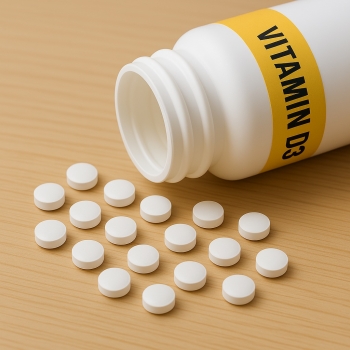
Taking vitamin D2 might lower the body's levels of the more efficient form of vitamin D, vitamin D3, according to new research from the University of Surrey, John Innes Center and Quadram Institute Bioscience. Many people take vitamin D supplements to support their bone and immune health and meet the UK government recommendation of 10 micrograms (µg) each day, especially during the winter months.
FAB RESEARCH COMMENT:
Most people need to take Vitamin D supplements at least during the winter months to maintain adequate levels, and modern lifestyles and diets mean that many need to do this all year round to avoid deficiency.The main sources of Vitamin D3 are all animal derived, but an alternative, plant-derived form - Vitamin D2 - is found in mushrooms and other funghi.
For many years, the D2 form has been used in many supplements and fortified foods, in keeping with the growing popularity and promotion of vegetarian, vegan and 'plant-based' diets more generally.
However, a systematic review of clinical trials in 2012 first cast serious doubt on the equivalence of D2 and D3 for health - and by 2017, a carefully designed and rigorous clinical trial confirmed that Vitamin D2 supplements were only half as effective as Vitamin D3 in raising blood levels of Vitamin D (serum 25(OH)D), leading to calls changes in official guidelines on Vitamin D which . See:
This new study, by leading researchers in the field, now shows that supplementation with Vitamin D2 may actually reduce levels of Vitamin D3 - the form made naturally by the action of bright sunlight on the skin.
As one of them emphasised:
"Vitamin D deficiency represents a significant public health concern, especially during the winter months with significant deficiency across the U.K. population.
"Tackling this with the most effective form of vitamin D supplementation or fortification is of the utmost importance to the health of the nation."
Read the underlying research here:
Evidence has long shown that inadequate Vitamin D status impairs not only bone health and immunity, but most aspects of general health and metabolism - including brain development and function.
For more information on the vital importance of Vitamin D - and the evidence linking Vitamin D deficiency to a wide range of different developmental and mental health conditions as well as co-occuring physical health problems, please see the following lists, which are regularly updated.
18th September 2025 - Medical Xpress
----------------------------------------
Taking vitamin D2 might lower the body's levels of the more efficient form of vitamin D, vitamin D3, according to new research from the University of Surrey, John Innes Center and Quadram Institute Bioscience.
Many people take vitamin D supplements to support their bone and immune health and meet the UK government recommendation of 10 micrograms (µg) each day, especially during the winter months.
There are two forms of vitamin D supplements available: vitamin D2 and vitamin D3.
Researchers have found that taking vitamin D2 supplements can lead to a drop in the body's concentration of vitamin D3, which is the form our bodies naturally produce from sunlight and use most effectively to raise overall vitamin D levels.
The study, published in Nutrition Reviews, analyzed data from randomized controlled trials and found that vitamin D2 supplementation resulted in a reduction in vitamin D3 levels compared to those not taking a vitamin D2 supplement. In many of the studies, the vitamin D3 levels went lower than in the control group.
Emily Brown, Ph.D. Research Fellow and Lead Researcher of the study from the University of Surrey's Nutrition, Exercise, Chronobiology & Sleep Discipline, said, "Vitamin D supplements are important, especially between October and March, when our bodies cannot make vitamin D from sunlight in the U.K.
"However, we discovered that vitamin D2 supplements can actually decrease levels of vitamin D3 in the body, which is a previously unknown effect of taking these supplements.
"This study suggests that subject to personal considerations, vitamin D3 supplements may be more beneficial for most individuals over vitamin D2."
Professor Cathie Martin, group leader at the John Innes Center, said, "This meta-analysis highlights the importance of ensuring plant-based vitamin D3 is accessible in the U.K."
This research supports a previous study published in Frontiers in Immunology, led by Professor Colin Smith from the University of Surrey, which suggests that vitamin D2 and D3 do not have identical roles in supporting immune function. Vitamin D3 has a modifying effect on the immune system that could fortify the body against viral and bacterial diseases.
Professor Colin Smith said, "We have shown that vitamin D3, but not vitamin D2, appears to stimulate the type I interferon signaling system in the body—a key part of the immune system that provides a first line of defense against bacteria and viruses. Thus, a healthy vitamin D3 status may help prevent viruses and bacteria from gaining a foothold in the body."
Further research into the different functionalities of vitamin D2 and D3 should be a priority in deciding whether vitamin D3 should be the first-line choice of vitamin D supplement, subject to individual requirements.
Professor Martin Warren, Chief Scientific Officer at the Quadram Institute, said, "Vitamin D deficiency represents a significant public health concern, especially during the winter months with significant deficiency across the U.K. population.
"This collaborative research effort aligns well with the Quadram Institute's mission to deliver healthier lives through food innovation to enhance the nutrient density of the food we eat.
"Tackling this with the most effective form of vitamin D supplementation or fortification is of the utmost importance to the health of the nation."

Food and Behaviour Research is a registered charity (No SC034604) and a company limited by guarantee (Co No SC 253448)
Newsletter Signup
Useful Links
Contact Us
FAB Research
23 Carlton Road
Oxford
OX2 7SA
Important Notice
Medical opinion and guidance should always be sought for any symptoms that might possibly reflect a known or suspected disease, disorder or medical condition. Information provided on this website (or by FAB Research via any other means) does not in any way constitute advice on the treatment of any medical condition formally diagnosed or otherwise.
Site by Redstone Websites. Easy to Use Web Content Management. 2026 © All Rights Reserved.